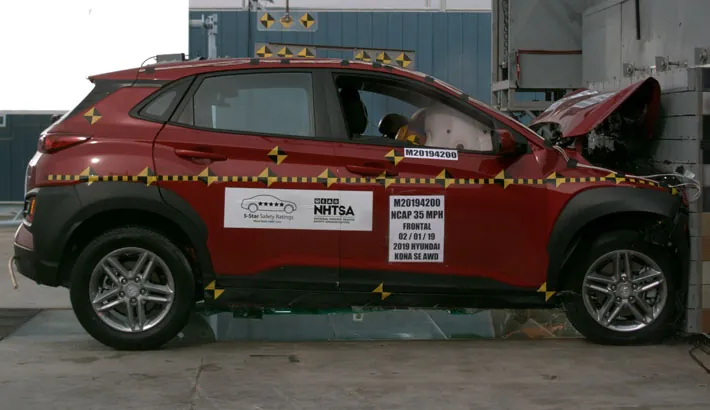
The Verdict
Worst problem area
Engine
Engine leads by volume: 149 of 252 complaints (59%) mention it. Complaints mentioning Driver Assistance & Speed Control include more reported injuries (4) than those mentioning any other identified area.
Complaints filed rose from 75 in 2018 to 252 in 2019.
At a glance
- NHTSA complaints
- 252
- Recall campaigns
- 5
- EPA fuel cost per year
- $2,100–$2,300
- Combined MPG
- 27–30
Complaints by model year
Where owners report problems
Cost, Fuel Economy & Complaint History
| Category | 2018 | 2019 | 2020 | 2021 | vs. 2019 Small Sport Utility Vehicle 2WD |
|---|---|---|---|---|---|
| Annual fuel cost ($) | 2,100–2,300 | 2,100–2,300 | 2,100–2,300 | 2,100–2,300 | |
| Combined MPG | 27–30 | 27–30 | 27–30 | 27–30 | |
| City / Highway MPG | 25–28 / 29–33 | 25–28 / 29–33 | 26–28 / 29–33 | 25–28 / 29–33 | |
| CO₂ tailpipe (g/mi) | 300–326 | 300–325 | 300–324 | 300–326 | |
| Complaints filed | 75 | 252 | 189 | 147 | |
| Recalls issued | 0 | 5 | 6 | 4 | |
| Crash-involved complaints | 9 | 13 | 9 | 3 | |
| Fire-involved complaints | 10 | 6 | 3 | 4 | |
| Injuries reported | 12 | 7 | 12 | 3 | |
| Deaths reported | 0 | 0 | 1 | 0 | |
| Configurations compared | 2 | 2 | 2 | 2 |
Not compared: this database has no vehicle sales or registration figures, so a raw count mostly reflects how many were sold, not how safe the vehicle is.
Common questions
How many recalls does the 2019 Hyundai Kona have?
5 NHTSA recall campaigns as of Nov 7, 2026. Check your VIN with NHTSA to see whether one applies to your car.
What is the most common complaint about the 2019 Hyundai Kona?
Engine: 149 of 252 NHTSA complaints (59%) mention it.
What gas mileage does the 2019 Hyundai Kona get?
EPA rates it 27–30 MPG combined.
How much does it cost to fuel a 2019 Hyundai Kona?
EPA estimates $2,100–$2,300 a year in fuel costs, using EPA's assumptions.
Similar Vehicles
EPA-Rated Configurations (5)
| Configuration | Transmission | Cylinders | Displacement | Drivetrain | Fuel Type | Vehicle Class | City | Highway | Combined | Annual Fuel Cost | CO₂ |
|---|---|---|---|---|---|---|---|---|---|---|---|
| Configuration 1 | Automatic (AM7) | 4 | 1.6L | Front-Wheel Drive | Regular | Small Sport Utility Vehicle 2WD | 28 mpg (high) | 32 mpg | 30 mpg (high) | $2,100 (low) | 303 g/mi |
| Configuration 2 | Automatic (AM7) | 4 | 1.6L | All-Wheel Drive | Regular | Small Sport Utility Vehicle 4WD | 26 mpg | 29 mpg (low) | 27 mpg (low) | $2,300 (high) | 324 g/mi |
| Configuration 3 | Automatic (S6) | 4 | 2.0L | Front-Wheel Drive | Regular | Small Sport Utility Vehicle 2WD | 27 mpg | 33 mpg (high) | 30 mpg (high) | $2,100 (low) | 300 g/mi (low) |
| Configuration 4 | Automatic (S6) | 4 | 2.0L | All-Wheel Drive | Regular | Small Sport Utility Vehicle 4WD | 25 mpg (low) | 30 mpg | 27 mpg (low) | $2,300 (high) | 325 g/mi (high) |
| Configuration 5 | Automatic (A1) | — | — | Front-Wheel Drive | Electricity | Small Sport Utility Vehicle 2WD | 132 MPGe | 108 MPGe | 120 MPGe | $650 | 0 g/mi |
Complaints by Category
| Category | Complaints | Crash-Involved | Fire-Involved | Injuries | Deaths |
|---|---|---|---|---|---|
| Engine | 149 | 2 | 4 | 1 | 0 |
| Transmission & Drivetrain | 24 | 1 | 0 | 0 | 0 |
| Fuel System | 20 | 0 | 0 | 0 | 0 |
| Electrical | 60 | 2 | 2 | 3 | 0 |
| Brakes | 7 | 3 | 1 | 3 | 0 |
| Steering | 1 | 0 | 0 | 0 | 0 |
| Suspension, Wheels & Tires | 2 | 0 | 0 | 0 | 0 |
| Airbags & Restraints | 5 | 5 | 1 | 2 | 0 |
| Driver Assistance & Speed Control | 22 | 3 | 0 | 4 | 0 |
| Body, Seats & Latches | 8 | 1 | 0 | 0 | 0 |
| Visibility & Lighting | 5 | 0 | 0 | 0 | 0 |
| Other | 25 | 3 | 1 | 1 | 0 |
A complaint that names more than one category is counted in each, so the rows can add up to more than the total number of complaints.
Recalls (5)
AIR BAGS: AIR BAG/RESTRAINT CONTROL MODULE:SOFTWARE
- Defect
- Hyundai Motor America (Hyundai) is recalling certain 2019-2022 Veloster N, 2019-2023 Kona Electric vehicles. A software error in the air bag control unit (ACU) may improperly deactivate the air bag system and seat belt pretensioners.
- Consequence
- Air bags and seat belt pretensioners that do not activate in a crash increases the risk of injury.
- Remedy
- Dealers will update the ACU software, free of charge. Owner notification letters are expected to be mailed January 1, 2027. Owners may contact Hyundai customer service at 1-855-371-9460. Hyundai's number for this recall is 311. Vehicle Identification Numbers (VINs) involved in this recall will become searchable on NHTSA.gov on November 6, 2026.
ENGINE
- Defect
- Hyundai Motor America (Hyundai) is recalling certain 2019-2020 Elantra, 2019-2021 Kona and Veloster vehicles equipped with 2.0L Nu MPI engines. The piston oil rings may not have been properly heat-treated, which could result in engine damage.
- Consequence
- A damaged engine may stall, increasing the risk of a crash. In addition, oil may leak onto hot exhaust components, increasing the risk of a fire.
- Remedy
- Dealers will inspect and, if necessary, replace the engine, free of charge. In addition, Hyundai will deploy Piston Ring Noise Sensing System (PNSS) software. Owner notification letters were mailed August 24, 2021. Owners may contact Hyundai customer service at 1-855-371-9460.
ELECTRICAL SYSTEM:PROPULSION SYSTEM:TRACTION BATTERY
- Defect
- Hyundai Motor America (Hyundai) is recalling certain 2019-2020 Kona Electric and 2020 Ioniq Electric vehicles. The lithium-ion (Li-ion) battery may short-circuit.
- Consequence
- An electrical short in the Li-ion battery increases the risk of a fire.
- Remedy
- Owners are advised to park their vehicles outside and away from structures until the interim action is complete. Hyundai will notify owners, and as an interim action, owners have the option to follow provided instructions to perform a battery update through the vehicle's infotainment system or request a Hyundai dealer to provide the update. Once parts are available, dealers will inspect the Battery System Assembly (BSA), and replace it if necessary. Repairs will be performed free of charge. Owners were notified of the safety risk, and the interim action, with a letter mailed April 9, 2021. Final owner notification letters were mailed June 17, 2021. Owners may contact Hyundai customer service at 1-855-371-9460. Hyundai's number for this recall is 200.
SERVICE BRAKES, HYDRAULIC:POWER ASSIST:ELECTRIC:CONTROL MODULE:SOFTWARE
- Defect
- Hyundai Motor America (Hyundai) is recalling certain 2019-2020 Nexo Fuel Cell and 2019-2021 Kona Electric vehicles. The Integrated Electronic Brake (IEB) system may detect an abnormal sensor signal and as a result, may significantly reduce braking performance.
- Consequence
- Reduced braking power could lengthen the distance required to stop the vehicle, increasing the risk of a crash.
- Remedy
- Hyundai will notify owners, and dealers will update the IEB software, free of charge. The recall began January 25, 2021. Owners may contact Hyundai customer service at 1-855-371-9460. Hyundai's number for this recall is 199.
ELECTRICAL SYSTEM:PROPULSION SYSTEM:TRACTION BATTERY; ELECTRICAL SYSTEM:PROPULSION SYSTEM:TRACTION BATTERY:MANAGEMENT SYSTEM/ENERGY CONTROL MODULE (BMS/BECM):SOFTWARE
- Defect
- Hyundai Motor America (Hyundai) is recalling certain 2019-2020 Kona Electric vehicles. The lithium-ion (Li-ion) battery may short-circuit.
- Consequence
- An electrical short in the Li-ion battery increases the risk of a fire.
- Remedy
- Hyundai will notify owners, and dealers will update the Battery Management System (BMS) software and inspect the Li-ion battery, replacing it if necessary, free of charge. Owners are advised to park their vehicles outside and away from structures until the repair is complete. The recall began November 13, 2020. Owners may contact Hyundai customer service at 1-855-371-9460. Hyundai's number for this recall is 196.