Put a midsize sedan and a full-size pickup nose to nose at 35 mph and the answer comes out of high-school physics. The heavier vehicle keeps more of its speed, so it shoves the lighter one backward, and the lighter one's occupants go through the bigger change in speed. Here's how big the gap is, using the EPA test weights RideTruth's crash comparison runs on.
How much does weight change a head-on crash?
Take the 2024 Camry at 3,750 lb and the 2024 F-150 at 5,500 lb, both doing 35 mph toward each other. Treat it as the simplest possible crash: they hit squarely and move off together. Momentum is conserved, and the change in speed (crash engineers call it delta-V) works out to:
Change in speed for car A = 2 × speed × weight of B ÷ (weight of A + weight of B)
For the Camry that's 2 × 35 × 5,500 ÷ 9,250, or 41.6 mph. For the F-150 it's 28.4 mph. The two wrecks end up rolling together at about 6.6 mph in the direction the truck was going. And the ratio between the two changes, 41.6 to 28.4, is exactly the ratio of the weights: 5,500 to 3,750.
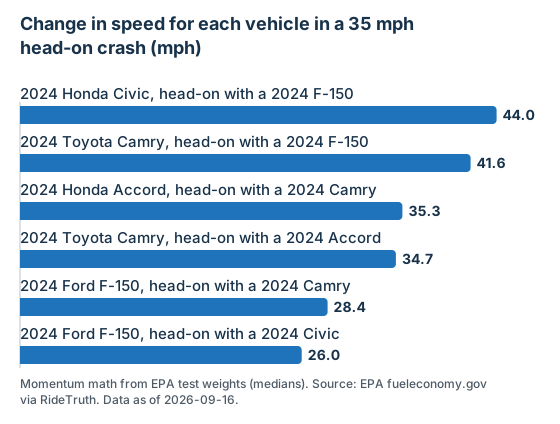
| Matchup at 35 mph each | EPA test weights (lb) | Change in speed (mph) |
|---|---|---|
| 2024 Civic vs 2024 F-150 | 3,250 vs 5,500 | 44.0 vs 26.0 |
| 2024 Camry vs 2024 F-150 | 3,750 vs 5,500 | 41.6 vs 28.4 |
| 2024 Accord vs 2024 Camry | 3,688 vs 3,750 | 35.3 vs 34.7 |
The Civic is 500 lb lighter than the Camry, so its number climbs again: 44.0 mph against the truck's 26.0. Between the Accord and the Camry, 62 lb apart, it's close to a wash.
Does the speed matter, or only the weight?
Both. Raise the speed and both vehicles' changes get bigger. The ratio between them stays at 5,500 to 3,750, because it comes from the weights alone. Here are the Camry and F-150 at three speeds:
| Both vehicles at | Camry's change in speed | F-150's change in speed |
|---|---|---|
| 25 mph | 29.7 mph | 20.3 mph |
| 35 mph | 41.6 mph | 28.4 mph |
| 55 mph | 65.4 mph | 44.6 mph |
What if the weights are off?
EPA test weights will be a little off for any one truck or car. EPA tests the same model year in several configurations, and the weights spread out. The 2024 F-150 has 13 EPA test entries running from 5,000 to 6,500 lb. The Camry has nine, from 3,625 to 3,875 lb. RideTruth uses the median of each.
So I checked the worst case for the argument: the lightest F-150 against the heaviest Camry, 5,000 vs 3,875 lb. The Camry's change in speed drops to 39.4 mph and the truck's rises to 30.6. The heaviest truck against the lightest Camry pushes it the other way, to 44.9 vs 25.1. Even at those extremes, the Camry still has the bigger change in speed.
Why don't NHTSA's star ratings settle this?
Because NHTSA's frontal test isn't a car-versus-truck test. The car drives into a fixed barrier at 35 mph, and NHTSA explains that setup as standing in for a crash between two vehicles of equal weight (NHTSA). A car hitting its own twin head-on at 35 mph changes speed by about 35 mph, and so does a car that stops dead against a barrier.
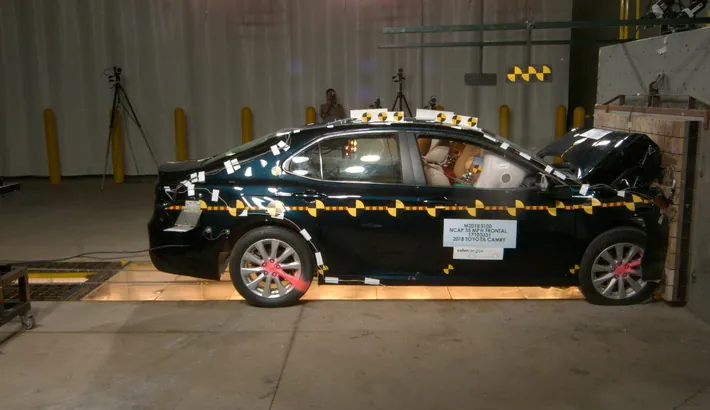
That's the photo NHTSA keeps on file for the 2024 Camry, and the placard on the door shows it's a 2018 test car.
So NHTSA limits the comparison. Frontal star ratings compare only vehicles in the same class within 250 pounds of each other. The agency's own advertising guidelines tell advertisers not to compare frontal stars across bigger gaps or different body styles. By EPA test weight, the Camry and the F-150 are 1,750 lb apart, and they aren't the same kind of vehicle. The Camry's frontal stars describe a crash with another car of about its own weight, and the F-150's describe a crash with another truck of about its own weight. Neither rating says what happens when one hits the other.
The Accord and Camry are the kind of pair the rule is meant for. On EPA test weights they're 62 lb apart, well inside NHTSA's 250-pound window, and both are sedans. The math agrees: 35.3 mph against 34.7, almost exactly what the barrier test assumes. The crash comparison shows both vehicles' NHTSA frontal ratings next to the math. For the Camry's complaints, recalls and fuel economy, see the 2024 Camry page.
What the delta-V math ignores
A lot. The formula treats both vehicles as blocks that meet squarely and stick together. Real crashes are often offset or angled, and the speeds rarely match. It also knows nothing about crumple zones, frame height, airbags or seat belts, which is what crash tests are built to capture. Change in speed tells you how hard the hit is on the vehicle as a whole. It doesn't predict what happens to any one person inside.
If you want to see the split for your own car, pick any two model years on the crash comparison and drag the speed slider. Browse the Toyota Camry and Ford F-150 hubs for other years.